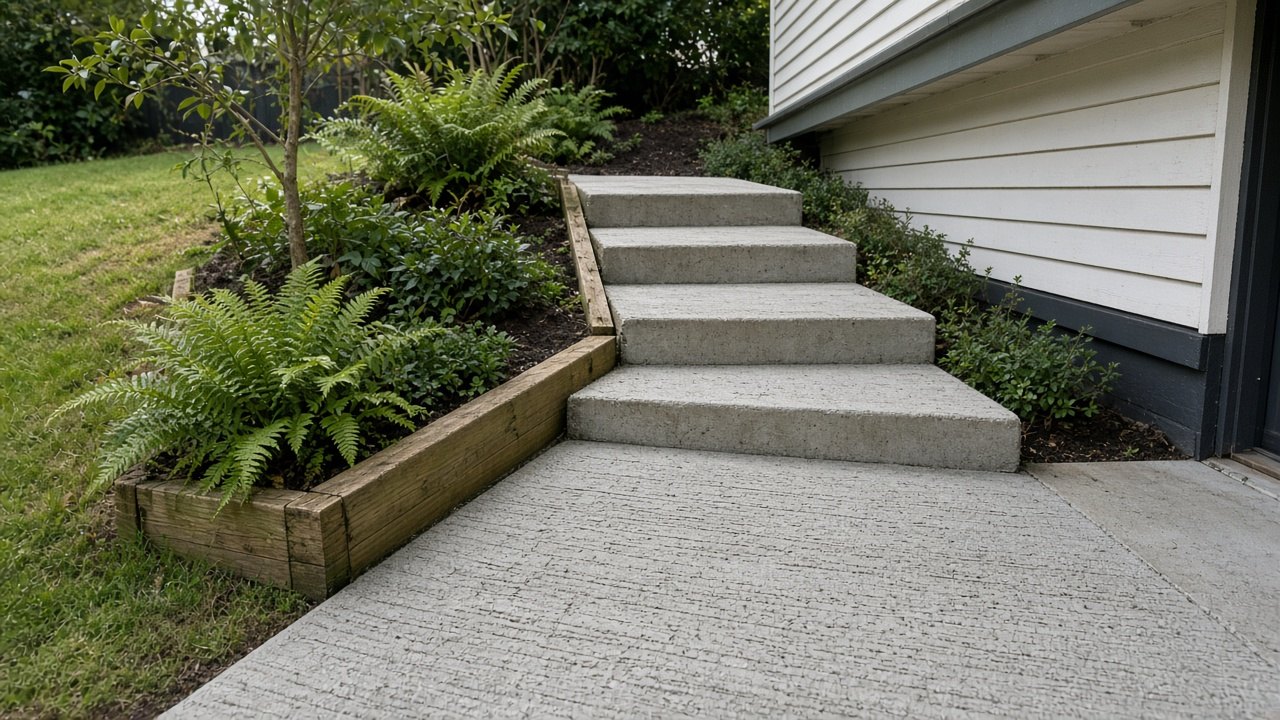
Plain broomed concrete in Korumburra
Plain broomed concrete is the honest workhorse of Korumburra driveways, farm tracks, side paths and shed aprons. Done well, it is grippy on hills, easy to maintain and built to last.
Email: info@korumburraconcreting.com.au
Simple does not mean basic
Plain concrete, usually finished with a broom to give texture, is the most widely used concrete surface in the district. It is practical, long-lasting and suits almost every kind of property, from a cottage near the town centre to a dairy farm on a ridge outside town. What separates a good plain slab from a poor one is not the colour. It is the base, the steel, the joints, the falls and the finishing, all of which matter as much here as on any decorative job.
Why a broom finish suits the hills
Korumburra is steep, wet and often cold in the mornings. A smooth trowelled slab on a sloping driveway or path can become slippery under rain, frost, moss or a layer of wet leaves. A broom finish drags fine ridges across the surface, giving tyres and shoes something to grip. On steeper slopes we use a firmer, coarser broom. On gentle patios or garage aprons we can use a finer broom for a neater look that is still safe.
The direction of the broom matters too. On a driveway or ramp, brooming across the slope gives the best grip for vehicles and people walking up and down.
Where plain concrete earns its keep
Plain concrete is the practical choice for long rural driveways, side paths along the house, bin pads, clothesline areas, shed aprons, water tank bases, trough pads and the back sections of driveways that run past sheds and workshops. It is also the base finish for many house slabs, garage floors and farm sheds. On properties where a decorative finish is used at the front, plain broomed concrete is often used for the working areas behind.
Borders and simple upgrades
A plain slab can be lifted with a few simple details. A smooth trowelled border band around the edge gives a crisp, finished look. Well-planned saw-cut joints in a regular pattern look deliberate and tidy. Tooled edges give a softer edge that resists chipping. None of these change the practicality of the slab, but they make a plain driveway look considered rather than cheap.
Preparation for Korumburra ground
The reactive clay found across much of Korumburra moves with the seasons. On slopes, the ground also tends to creep downhill over time. We excavate to firm ground, remove topsoil and soft material, and compact crushed rock in layers. Steel goes on chairs so it sits within the slab. Joints are spaced to control shrinkage cracking. On steeper sites, we shape the subgrade carefully so the slab is a consistent thickness rather than thin at the edges.
Drainage is a big part of the design. A plain driveway still needs falls to direct water away from the house and garage, and on longer runs grated drains or spoon drains to control the flow. Where a path or driveway cuts across the slope, we think about the water coming from uphill as well as the rain landing on the slab.
Strength and thickness
Thickness and mix strength are chosen to suit the use. A side path carries foot traffic and a wheelbarrow. A shared driveway carries cars and occasional delivery vans. A farm track or shed apron may carry loaded trucks, tractors and feed wagons. We discuss what will use the slab and size it accordingly, rather than applying one thickness everywhere.
Maintenance
Plain concrete needs very little care. Sweep or hose it down, deal with oil spills promptly, and keep moss in check on shaded paths with a stiff broom or a suitable cleaner. Sealing is optional on plain concrete. It can help with stain resistance on garage floors and outdoor entertaining areas, but many plain driveways and farm slabs are left unsealed.
Replacing old plain concrete
Old plain concrete paths and driveways that have cracked, dropped or lifted are a common sight on Korumburra's older streets, often because they were poured thin or straight onto clay. We break out and remove the old slab, assess the ground underneath, rebuild the base and pour a new slab with proper joints and falls. Where only some panels have failed, we will tell you if replacing just those sections makes sense.
Plain concrete for practical, long-lasting farm and house work
Many Korumburra properties need large areas of hard-wearing concrete that simply works: the turning area beside a shed, the parking pad for a trailer, the access path to a water tank or pump shed. In those places, plain broomed concrete is the right choice because it is practical, grippy and easy to repair in sections later. Spending the budget on proper excavation, base and steel instead of decorative finishes gives the best long-term result.
Joints and edges that last
On plain concrete, the joints and edges are the details people notice. We cut joints at the right time and depth so they control cracking, and form edges neatly so they do not crumble where lawn mowers and wheelbarrows run along them. Those small details are what make a plain slab look professionally finished.
Speed and simplicity
Because plain broomed concrete needs no decorative stone, colour or stamping, it is usually the quickest finish to place, which makes it ideal for working areas that need to be back in use quickly.
Korumburra clay, slopes and South Gippsland rules
Korumburra sits high in the hills of South Gippsland, at the edge of the Strzelecki foothills, in country that was cleared for dairying and once mined for black coal. Under the grass most blocks have heavy, reactive clay over weathered sandstone and mudstone. That clay swells in a wet winter and shrinks in a dry summer, and on a slope it also wants to creep downhill. A slab poured thin, straight onto it, will crack and move.
So we dig to firm ground, take out topsoil and soft material, compact crushed rock in layers, set steel on chairs, and plan joints and drainage before the pour. Falls are designed to take water safely down the hill, away from the house and garage, to a legal point of discharge. High rainfall makes compaction harder in winter, and frost and cold slow curing, so we plan around the season. Concrete inside your boundary rarely needs a council permit. Work in the road reserve, such as a crossover, nature strip or public footpath, generally needs the council's consent. A slab that carries a building needs a building permit and engineering. Your quote spells out which of these apply.
How a Korumburra quote is put together
Every quote we send is written and itemised. It sets out the area we measured, the digging and where the spoil or old concrete will go, the compacted crushed-rock base, the slab thickness, the steel and how it is supported, the finish, any sealer, and the extras that hilly blocks often need: drains, steps, a small wall, a landing or a new crossover. If South Gippsland Shire, the state road authority or a building surveyor has to be involved, the quote names that up front.
It also covers the practical side of pour day: where the truck or pump can stand on a steep street, how we protect gardens, fences and the footpath, and how long the area must stay closed. If we suspect the ground hides a problem, such as wet clay, an old slab, a spring or a buried pipe, we say so and explain how we would deal with it. There are no prices on this website because two blocks on the same Korumburra street can need very different work. The visit and the written quote cost you nothing.
What you get with Korumburra Concreting
Local to Korumburra 3950
We work the town first, then the South Gippsland towns and farming districts we actually drive to every week.
Built for hills, clay and rain
Deeper prep where reactive clay needs it, compacted bases, and falls that take water safely down a sloping block.
Free written quotes
Every job is itemised. No website rates, no pressure, and no charge to visit or to send the quote.
Home and farm work
From house slabs and driveways to machinery shed floors and yards, with council and permit steps named in the quote.
Six steps to a finished job
- 1
Get in touch
Call, email or send the form with a few photos of the area, the street frontage and any steep or tight access.
- 2
Site visit
We measure, check the levels and the slope, look at the ground and drainage, and bring finish samples to hold against the house.
- 3
Written quote
You get an itemised quote covering digging, base, thickness, steel, finish, drains and any council or permit work.
- 4
Base and formwork
We remove old concrete or topsoil, dig out soft clay, compact the base, set the forms and place the steel on chairs.
- 5
Pour and finish
Concrete is placed, levelled and finished for grip on the slope, then protected while it cures in the week's weather.
- 6
Clean-up and care
We strip the forms, cut joints, take the rubble away, seal if it was quoted, and leave written care notes.
Plain Concrete questions
Is plain concrete cheaper than exposed aggregate?
Plain broomed concrete generally costs less to place because it uses a standard mix and takes less finishing time. The base preparation, though, is the same. We quote both if you would like to compare.
Will a broom finish stay grippy?
Yes. A broom finish keeps its texture for many years. Moss and algae on shaded paths can reduce grip, so an occasional scrub helps.
Do I need to seal plain concrete?
It is optional. Sealing can help resist stains in garages and entertaining areas. Many driveways and farm slabs are left unsealed.
Can plain concrete be coloured later?
Pigment cannot be added to an existing slab, but sound plain concrete can sometimes be resurfaced or given a tinted sealer. We assess whether it is worthwhile.
Where we work
Other concreting services
Talk to a Korumburra concreter
We visit, measure and put it in writing for work in Korumburra 3950 and the South Gippsland towns around it. Nothing on this site is priced, because no two blocks are the same.