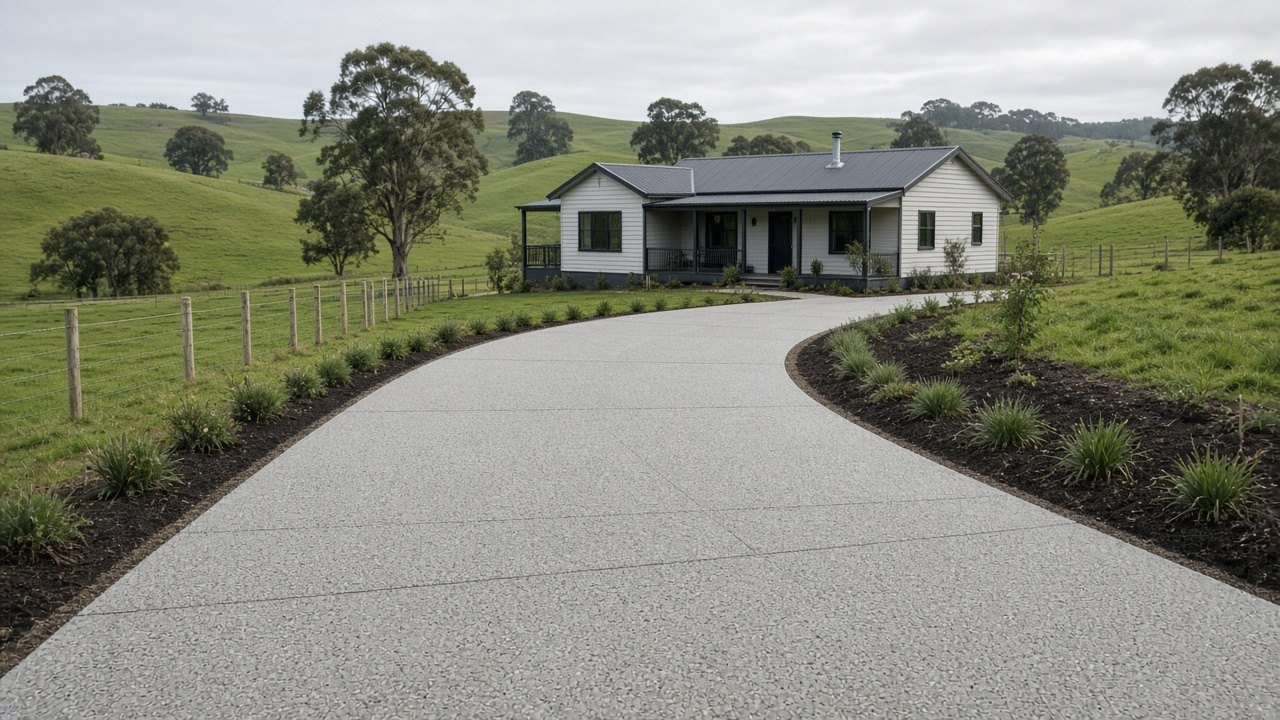
Concrete driveways in Korumburra
A Korumburra driveway has to climb, turn and shed water on heavy hill-country clay. We design the grade, the base and the drainage first, then pour a finish that suits the house.
Email: info@korumburraconcreting.com.au
Driveways on hills, not flat estates
Very few driveways in Korumburra are flat. The town is built across a run of ridges and gullies at the edge of the Strzelecki foothills, so most blocks either fall towards the street or rise sharply away from it. That changes almost everything about a driveway. The grade decides whether a car scrapes its nose at the kerb. The slope decides how fast rainwater runs down the slab and where it ends up. The cut into the hill decides whether the edge of the drive stays put or slowly creeps.
We start every driveway quote by standing at the street and walking up or down the block with a level. We look at the transition from the road to the crossover, the steepest part of the run, the point where the drive meets the garage or the carport, and every place where water already collects. Those four spots decide the design long before anyone talks about exposed aggregate or colour.
The clay underneath the slab
The soil across much of Korumburra is heavy, reactive clay sitting over weathered sandstone and mudstone. In a wet South Gippsland winter that clay swells and turns to grease. Through a dry February it shrinks and cracks. A driveway poured straight onto that surface will ride up and down with it, and the cracks usually show at the steepest section first, because that is where the slab is also trying to slide.
So the work under the concrete gets the most attention. We strip the topsoil and any soft or organic material, dig down to firm ground, and compact crushed rock in layers so the slab sits on a stable, free-draining bed. On a sloping run we often step the subgrade rather than leaving one long wedge of fill. Where the drive sits on a cut, we look at whether the batter beside it needs a small wall, a dish drain or simply better shaping so it does not wash onto the new concrete every time it rains.
Grade, transitions and the scrape test
A steep drive is fine as long as the changes in grade are gentle. The problems happen at the breakover points: where the crossover meets the footpath, where a steep section meets a flatter landing, and where the drive meets the garage floor. Low cars and towbars find those points straight away. We set out the levels so each change is gradual, and on very steep blocks we add a flatter landing near the garage so a car can stop and a door can open without the vehicle rolling.
Surface texture matters more on a slope as well. A steep smooth-trowelled drive can be dangerous on a frosty Korumburra morning or under a film of wet leaves. A firm broom finish, exposed aggregate, or a broom finish with a trowelled border gives tyres and shoes something to grip. We will tell you honestly if a finish you like is a poor match for the grade.
Getting water off the slab
On a hill, water is always moving. Rain falling on a long drive gathers speed and volume as it runs, and if it is not caught it will undercut the edges, flood a garage or pour across the neighbour's lawn. We design the falls so water is pushed to one side or into a central spoon drain, and we put grated drains across the drive where it meets the garage or where a long run needs to be broken up. Those drains need somewhere legal to go, which on most Korumburra blocks means the legal point of discharge at the street or an existing stormwater line. We check where that is before we quote.
Where a drive cuts across the slope, water from the high side matters as much as the rain that lands on the slab. A shallow dish drain or a kerb along the uphill edge stops the hill from washing onto the concrete. On some blocks a small agricultural drain behind the edge is the difference between a dry drive and a constantly damp one.
Thickness, steel and joints
We size the slab for what will use it. A standard family car needs less than a ute towing a horse float or a delivery truck reversing up to a shed. Steel reinforcement goes on bar chairs so it sits in the right part of the slab rather than on the ground. We plan saw-cut control joints so that, when the concrete shrinks as it cures, it cracks neatly in a straight line where we want it, not randomly across the middle of a panel. Isolation joints separate the drive from the house, the garage slab, the crossover and any pits.
Finishes that suit the town
Many Korumburra homes are weatherboard or older brick on established streets, and newer houses sit on the estates around the edge of town. Plain broom finish, exposed aggregate and coloured concrete all suit those houses in different ways. Exposed aggregate is popular for the front section because it is grippy and hides the red clay that ends up on every surface during winter. Plain broomed concrete is practical and honest for long rural runs. Coloured concrete in a soft grey or charcoal can lift an older house without looking out of place. We bring samples so you can see them against the house, not just on a screen.
Replacing an old driveway
A lot of our driveway work in Korumburra is replacement: an old cracked slab, a drive that has dropped at one edge, a gravel track that turns to mud each winter, or a strip drive that no longer suits the family. We break out and remove the old concrete, check what was underneath, and rebuild the base properly. If only part of a drive has failed, we will say so and quote the sections that need replacing rather than the whole lot.
What happens on the day
On pour day the base is already compacted, the formwork is set and the steel is in. Access matters on Korumburra streets, so we plan where the truck stands, whether a pump or a barrow run is needed, and how to keep the street and footpath clean. After finishing, the drive is kept closed to cars until it has gained enough strength, and we cut joints at the right time. You get written care notes for the first weeks.
Korumburra clay, slopes and South Gippsland rules
Korumburra sits high in the hills of South Gippsland, at the edge of the Strzelecki foothills, in country that was cleared for dairying and once mined for black coal. Under the grass most blocks have heavy, reactive clay over weathered sandstone and mudstone. That clay swells in a wet winter and shrinks in a dry summer, and on a slope it also wants to creep downhill. A slab poured thin, straight onto it, will crack and move.
So we dig to firm ground, take out topsoil and soft material, compact crushed rock in layers, set steel on chairs, and plan joints and drainage before the pour. Falls are designed to take water safely down the hill, away from the house and garage, to a legal point of discharge. High rainfall makes compaction harder in winter, and frost and cold slow curing, so we plan around the season. Concrete inside your boundary rarely needs a council permit. Work in the road reserve, such as a crossover, nature strip or public footpath, generally needs the council's consent. A slab that carries a building needs a building permit and engineering. Your quote spells out which of these apply.
How a Korumburra quote is put together
Every quote we send is written and itemised. It sets out the area we measured, the digging and where the spoil or old concrete will go, the compacted crushed-rock base, the slab thickness, the steel and how it is supported, the finish, any sealer, and the extras that hilly blocks often need: drains, steps, a small wall, a landing or a new crossover. If South Gippsland Shire, the state road authority or a building surveyor has to be involved, the quote names that up front.
It also covers the practical side of pour day: where the truck or pump can stand on a steep street, how we protect gardens, fences and the footpath, and how long the area must stay closed. If we suspect the ground hides a problem, such as wet clay, an old slab, a spring or a buried pipe, we say so and explain how we would deal with it. There are no prices on this website because two blocks on the same Korumburra street can need very different work. The visit and the written quote cost you nothing.
What you get with Korumburra Concreting
Local to Korumburra 3950
We work the town first, then the South Gippsland towns and farming districts we actually drive to every week.
Built for hills, clay and rain
Deeper prep where reactive clay needs it, compacted bases, and falls that take water safely down a sloping block.
Free written quotes
Every job is itemised. No website rates, no pressure, and no charge to visit or to send the quote.
Home and farm work
From house slabs and driveways to machinery shed floors and yards, with council and permit steps named in the quote.
Six steps to a finished job
- 1
Get in touch
Call, email or send the form with a few photos of the area, the street frontage and any steep or tight access.
- 2
Site visit
We measure, check the levels and the slope, look at the ground and drainage, and bring finish samples to hold against the house.
- 3
Written quote
You get an itemised quote covering digging, base, thickness, steel, finish, drains and any council or permit work.
- 4
Base and formwork
We remove old concrete or topsoil, dig out soft clay, compact the base, set the forms and place the steel on chairs.
- 5
Pour and finish
Concrete is placed, levelled and finished for grip on the slope, then protected while it cures in the week's weather.
- 6
Clean-up and care
We strip the forms, cut joints, take the rubble away, seal if it was quoted, and leave written care notes.
Concrete Driveways questions
How steep can a concrete driveway be in Korumburra?
Steep drives are common here and they can be done well. The limit is usually comfort and safety rather than the concrete itself. We set gentle changes in grade, add a landing near the garage if needed, and choose a finish that grips on a wet or frosty morning.
Do I need a permit for a new driveway?
Work inside your boundary usually does not need a permit. The crossover and anything in the road reserve normally needs South Gippsland Shire consent, and highway frontages can involve the state road authority. We confirm this on the visit and include it in the quote.
Why do driveways crack on clay?
Reactive clay swells when wet and shrinks when dry. If the base is thin or the slab has no planned joints, that movement shows up as random cracks. Good excavation, a compacted crushed-rock base, steel on chairs and saw-cut joints keep the movement under control.
How long before I can drive on a new driveway?
Foot traffic is usually fine after a day or so, but cars should stay off for longer while the concrete gains strength. We give you a clear date based on the weather during the pour and the mix used.
Where we work
Other concreting services
Talk to a Korumburra concreter
We visit, measure and put it in writing for work in Korumburra 3950 and the South Gippsland towns around it. Nothing on this site is priced, because no two blocks are the same.