A practical guide to concrete driveways on Korumburra's hills
Most Korumburra driveways are on a slope, sit on heavy clay and take a lot of rain. This guide explains, in plain language, what those three things do to a concrete driveway, what we look at on a visit, and how a hillside driveway is designed and prepared so it lasts.
Email: info@korumburraconcreting.com.au
Why a hill changes everything
On a flat block, a driveway is mostly about the base, the slab and the finish. On a slope, three more things come into play: the grade and how it changes, the water running down the surface, and the ground itself trying to move downhill. Korumburra's streets climb and drop across ridges and gullies, and many homes sit well above or below the road. That means most driveways in town have to deal with all three.
Getting the grade wrong leads to cars scraping at the kerb or the garage. Getting the water wrong leads to flooded garages, washed-out edges and slippery surfaces. Getting the ground wrong leads to cracking, separation from the garage and slabs that slowly creep. A good hillside driveway handles all of them.
What we look at on a first visit
We start at the road, because the crossover and the transition from the street are often the steepest and most awkward part. We check the kerb, the channel, the footpath if there is one, and the slope of the nature strip. Then we walk up or down the block with a level and note the grade at each section, the points where the grade changes, and where the driveway meets the garage, carport or parking area.
We look closely at the ground: how much topsoil there is, whether the clay is wet or dry, whether there are signs of old fill or soft spots, and whether the cut banks beside the driveway are stable. We note where water already runs and collects, where downpipes discharge, and where the legal point of stormwater discharge is. We also check access for a concrete truck or pump, because steep, narrow driveways can limit what equipment can reach the work.
Grades, breakover points and landings
The overall steepness of a driveway matters less than how the grade changes. Cars scrape at breakover points: where a steep section meets a flatter one, or where the driveway meets the road or the garage floor. We design gradual transitions at those points so the front and rear of a car, and any towbar, clear the surface.
On very steep driveways, a flatter landing near the garage is often worth including. It gives a car somewhere to stop safely, makes opening doors easier, and stops vehicles rolling toward the garage door. If you tow a trailer, caravan or float, or own a low car, tell us so we can design for it.
Excavation and base on reactive clay
Korumburra's clay swells when wet and shrinks when dry. On a slope, it also moves slowly downhill. A slab poured straight onto that surface will move with it. So we excavate below the topsoil to firm ground, remove soft and wet clay, and build a compacted crushed-rock base in layers.
On sloping ground, we shape the subgrade so the slab is a consistent thickness. A common mistake is to pour a slab that is thick in the middle and thin at the edges because the ground was not shaped properly. The thin edges then crack and break away. We also look at whether the subgrade should be stepped on very steep sections, so the base does not slide.
Steel, thickness and joints
We size the slab thickness and steel for the vehicles that will use the driveway and the ground conditions. Steel is placed on bar chairs so it sits within the slab rather than on the ground. Extra bars may be placed at grade changes, corners and around pits.
Control joints are saw cut at planned spacings so that, as the concrete shrinks during curing, it cracks along the joint lines rather than randomly. Isolation joints separate the driveway from the house, garage, crossover and pits so each can move independently. On steep driveways poured in sections, construction joints are placed where they align with the saw-cut pattern.
Water: the biggest enemy on a slope
Rain falling on a long sloping driveway gathers speed and volume as it runs. If it is not controlled, it undercuts the edges, floods garages and carries clay and gravel onto the surface. We design crossfalls so water moves to one side, and include grated drains across the driveway at the bottom of steep runs and in front of garages. These drains need to connect to a legal point of discharge.
Water coming from uphill matters too. Where a driveway cuts across a slope, a dish drain, kerb or small retaining wall on the high side stops the hill from washing onto the driveway. On wet sites, an agricultural drain behind the uphill edge can keep the base dry.
Finishes for grip and practicality
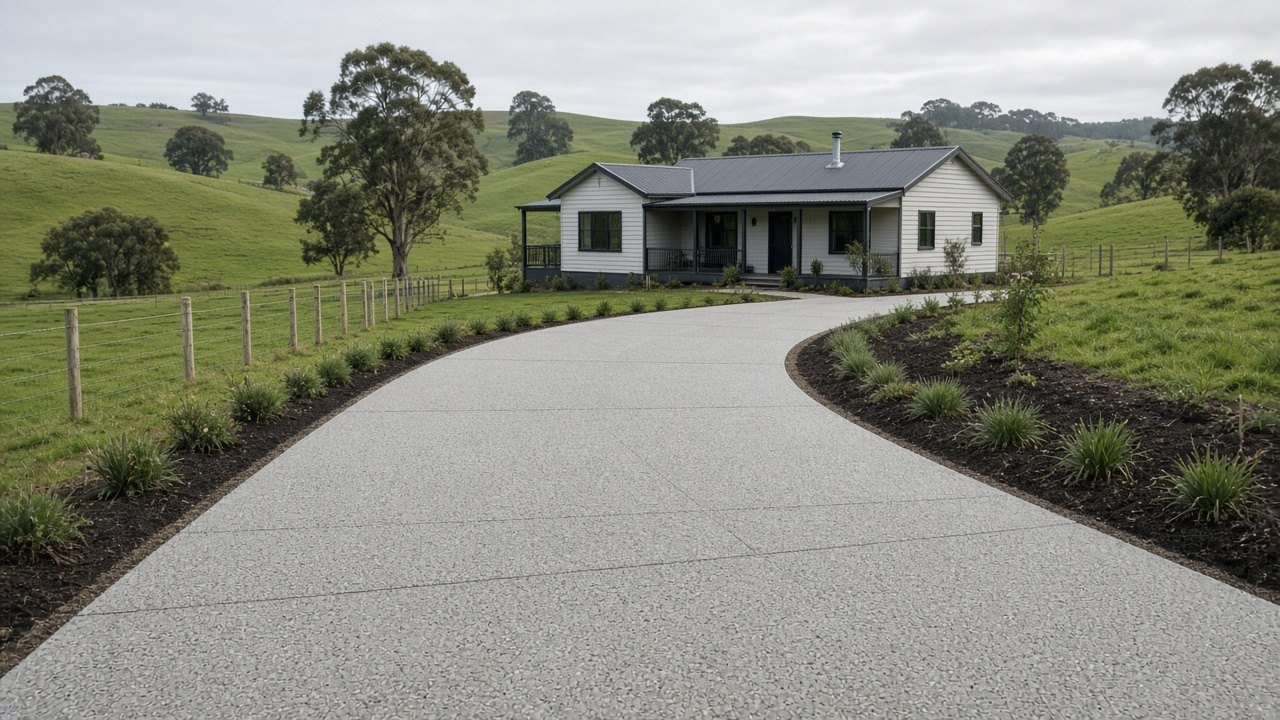
On a slope, the finish needs to grip. A smooth trowelled finish can be dangerous when wet, frosty or covered in leaves. A firm broom finish, applied across the slope, gives good grip. Exposed aggregate grips well and hides clay and tyre marks. Coloured concrete with a broom finish is another option. Stamped finishes with glossy sealers are generally best avoided on steep driveways.
If you plan to seal, choose a sealer suited to trafficked outdoor surfaces, and consider adding a slip-resistant additive.
Pouring a steep driveway
Steep driveways are often poured in sections so the concrete can be placed and finished properly without slumping downhill. Access for the truck and pump is planned beforehand. On pour day, the crew places, levels and finishes each section, protects the surface, and cuts joints at the right time. Cars stay off the driveway until it has gained enough strength.
Common mistakes on hillside driveways
The failures we see most often on older Korumburra driveways follow a pattern. The slab was poured on topsoil or soft clay with little or no crushed rock. The edges were left thin because the ground was never shaped. No control joints were cut, so the slab cracked wherever it wanted. The falls pushed water toward the garage. The grade change at the kerb was too sharp, so every car scraped. And a smooth finish was used on a steep section, so the driveway became slippery in winter. Each of these is avoidable with careful design and preparation, and each is much harder to fix after the concrete is in.
Partial replacement or full replacement?
Not every tired driveway needs to be replaced completely. If one or two panels have cracked and dropped while the rest are sound and draining well, replacing just those panels can be sensible. If the whole slab has moved, the falls are wrong, or water is getting into the garage, full replacement with a proper base and drainage is usually the better investment. We give you an honest view on the visit and can quote both options where it makes sense.
Looking after a new hillside driveway
Keep cars off the new driveway until we say it has gained enough strength, usually longer in cold weather. Keep drains clear of leaves and silt, especially before winter, because a blocked drain at the bottom of a steep driveway quickly sends water where you do not want it. Hose off clay and mud regularly so it does not stain the surface. If the driveway is sealed, reseal when water stops beading. Watch the cut banks beside the driveway after heavy rain and deal with any washouts early.
A short checklist before you accept any driveway quote
Does the quote describe the excavation depth and the base? Does it state the slab thickness and the steel? Does it show how water will be managed, including drains and where they discharge? Does it describe the joints? Does it mention the crossover and any council consent? Does it address grade changes at the road and garage? Does it describe the finish and any sealing? Does it say who removes old concrete and spoil? A quote that answers all of these is far easier to compare, and far less likely to lead to surprises.
Talk to a Korumburra concreter
We visit, measure and put it in writing for work in Korumburra 3950 and the South Gippsland towns around it. Nothing on this site is priced, because no two blocks are the same.