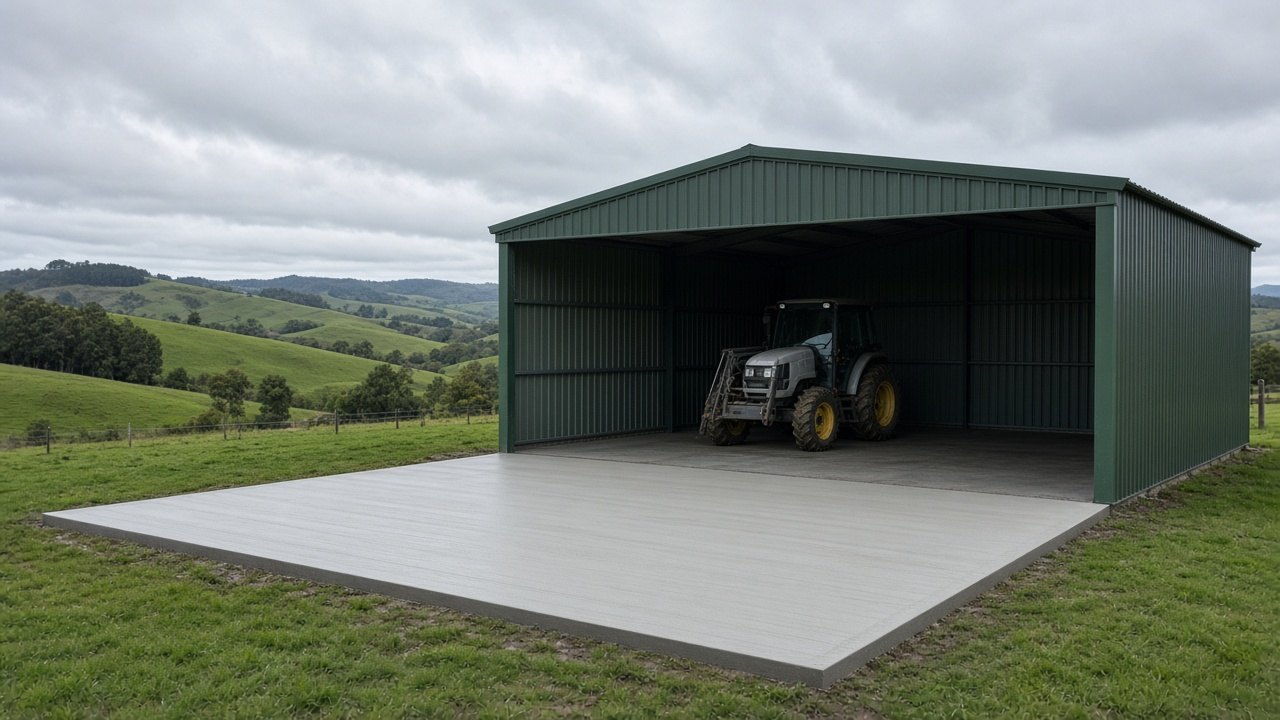
Farm and rural concreting around Korumburra
Korumburra is dairy and grazing country. We pour machinery shed floors, hay shed slabs, yards, calf shed floors, troughs pads and farm entrances that stand up to stock, tractors and South Gippsland winters.
Email: info@korumburraconcreting.com.au
Concrete for working properties
The hills around Korumburra are some of the most productive dairy and beef country in Victoria. Properties here deal with high rainfall, steep laneways, heavy machinery and stock that churn soft ground into mud within days. Concrete on a farm is not decoration. It is how you keep machinery clean, stock out of the mud, feed off the ground and vehicles moving through a wet season.
We pour rural slabs from small trough pads and gateway aprons up to large machinery and hay shed floors. Each job is planned around how the area will actually be used, by what, and how often.
Machinery and hay shed floors
A shed floor that carries a tractor, a loader, a feed wagon or a truck needs more than a standard house-yard slab. We size the thickness and reinforcement for the heaviest machine likely to use it, and we pay close attention to the entry apron where wheels turn and brake. The base is excavated well clear of topsoil and compacted crushed rock is built up in layers. On sloping sites we form a level pad and manage the cut so water from the hill does not run straight into the shed.
Hay shed floors need to stay dry. A slab with a slight fall to the open side, a raised edge where needed, and good drainage around the shed keeps bales off damp ground and reduces spoilage.
Yards, feed pads and laneway crossings
Concrete yards and feed pads take enormous punishment from hooves, manure, scraping and wash-down. A broom or grooved finish gives stock grip, and the falls are set so effluent and wash water go where your effluent system needs them to go. We discuss the edge details, the joint layout and the thickness with you, because a cracked or slippery yard is both a welfare and a productivity problem.
Laneway crossings, gateways and trough surrounds are smaller jobs that make a big difference. A concrete apron at a busy gateway stops the churned mud hole that forms every winter. A pad around a water trough keeps the area firm and clean.
Calf sheds, dairies and wash areas
Calf shed floors, vat stands, wash bays and small dairy extensions need finishes that drain well and can be cleaned easily. We work to falls that move water to drains or pits, and use finishes that balance grip with cleanability. Where food safety or dairy compliance requirements apply, we follow the specifications provided by your processor, consultant or engineer.
Farm entrances and long rural driveways
Long gravel driveways on hilly farms often wash out on the steep pinches and turn to mud near the house and sheds. Concreting the steepest sections, the house end and the shed area can solve most of the trouble without paving the whole run. Strip driveways, with two wheel tracks and a grassed centre, are another practical option on long, straight runs. At the road, the entrance and any culvert crossing may need council consent, so we check that before quoting.
Working with the season and the farm calendar
Rural jobs fit around calving, silage and the weather. Wet winter ground can make access and compaction difficult, so many farm slabs are best planned for drier months. We are flexible about timing and will work with you to avoid busy periods. On pour day we plan truck access across the property carefully, including where the agitator or pump can stand without bogging or damaging laneways.
Durability and the right mix
Farm concrete faces things a house driveway never sees: acidic effluent, fertiliser, chemicals, heavy point loads and constant moisture. The mix strength, cover to steel and curing all matter more in these settings. We discuss the right mix for your use and make sure the slab is cured properly so its surface is hard and durable.
Repairs and extensions
Old cracked yards, broken shed entries and sunken aprons can often be repaired by cutting out and replacing failed sections. Extending an existing shed floor or yard is also common. We prepare a clean, keyed joint and tie into the old slab where appropriate so the new section works with the existing one.
Effluent, wash water and where it goes
Any concrete area where stock stand or where machinery is washed needs a plan for the water that comes off it. Yards and feed pads usually drain to an effluent system, and wash bays may need a silt trap. We set falls and drains to suit your existing system or the design from your consultant, and avoid sending dirty water toward creeks, dams or the house.
Planning for future expansion
Farms change. A shed may be extended, a yard enlarged or a feed pad added. If future expansion is likely, we can design the slab edge and joints so a new section can be tied in neatly later, saving time and avoiding awkward joins. Tell us what you might add in the next few years and we will plan the layout with that in mind.
Korumburra clay, slopes and South Gippsland rules
Korumburra sits high in the hills of South Gippsland, at the edge of the Strzelecki foothills, in country that was cleared for dairying and once mined for black coal. Under the grass most blocks have heavy, reactive clay over weathered sandstone and mudstone. That clay swells in a wet winter and shrinks in a dry summer, and on a slope it also wants to creep downhill. A slab poured thin, straight onto it, will crack and move.
So we dig to firm ground, take out topsoil and soft material, compact crushed rock in layers, set steel on chairs, and plan joints and drainage before the pour. Falls are designed to take water safely down the hill, away from the house and garage, to a legal point of discharge. High rainfall makes compaction harder in winter, and frost and cold slow curing, so we plan around the season. Concrete inside your boundary rarely needs a council permit. Work in the road reserve, such as a crossover, nature strip or public footpath, generally needs the council's consent. A slab that carries a building needs a building permit and engineering. Your quote spells out which of these apply.
How a Korumburra quote is put together
Every quote we send is written and itemised. It sets out the area we measured, the digging and where the spoil or old concrete will go, the compacted crushed-rock base, the slab thickness, the steel and how it is supported, the finish, any sealer, and the extras that hilly blocks often need: drains, steps, a small wall, a landing or a new crossover. If South Gippsland Shire, the state road authority or a building surveyor has to be involved, the quote names that up front.
It also covers the practical side of pour day: where the truck or pump can stand on a steep street, how we protect gardens, fences and the footpath, and how long the area must stay closed. If we suspect the ground hides a problem, such as wet clay, an old slab, a spring or a buried pipe, we say so and explain how we would deal with it. There are no prices on this website because two blocks on the same Korumburra street can need very different work. The visit and the written quote cost you nothing.
What you get with Korumburra Concreting
Local to Korumburra 3950
We work the town first, then the South Gippsland towns and farming districts we actually drive to every week.
Built for hills, clay and rain
Deeper prep where reactive clay needs it, compacted bases, and falls that take water safely down a sloping block.
Free written quotes
Every job is itemised. No website rates, no pressure, and no charge to visit or to send the quote.
Home and farm work
From house slabs and driveways to machinery shed floors and yards, with council and permit steps named in the quote.
Six steps to a finished job
- 1
Get in touch
Call, email or send the form with a few photos of the area, the street frontage and any steep or tight access.
- 2
Site visit
We measure, check the levels and the slope, look at the ground and drainage, and bring finish samples to hold against the house.
- 3
Written quote
You get an itemised quote covering digging, base, thickness, steel, finish, drains and any council or permit work.
- 4
Base and formwork
We remove old concrete or topsoil, dig out soft clay, compact the base, set the forms and place the steel on chairs.
- 5
Pour and finish
Concrete is placed, levelled and finished for grip on the slope, then protected while it cures in the week's weather.
- 6
Clean-up and care
We strip the forms, cut joints, take the rubble away, seal if it was quoted, and leave written care notes.
Farm and Rural Slabs questions
How thick should a machinery shed slab be?
It depends on the heaviest machine and how often it is used. A slab for a ride-on mower is very different to one for a loaded truck or telehandler. We size thickness and steel for your actual equipment and will follow an engineer's design where one is required.
Do farm sheds need a building permit?
Many farm sheds do need a building permit, and some may be exempt depending on size and use. Check with your building surveyor or the shire. We pour to the design that comes with the permit.
Can you concrete just the muddy sections of a farm track?
Yes. Concreting the steep pinches, the gateways and the shed end of a track is often the most cost-effective approach. We look at the whole track and suggest where concrete will do the most good.
What finish is best for cattle yards?
A rough broom or grooved finish gives stock grip and still allows cleaning. The exact pattern depends on the use, whether it is scraped or washed, and the size of the stock.
Where we work
Other concreting services
Talk to a Korumburra concreter
We visit, measure and put it in writing for work in Korumburra 3950 and the South Gippsland towns around it. Nothing on this site is priced, because no two blocks are the same.