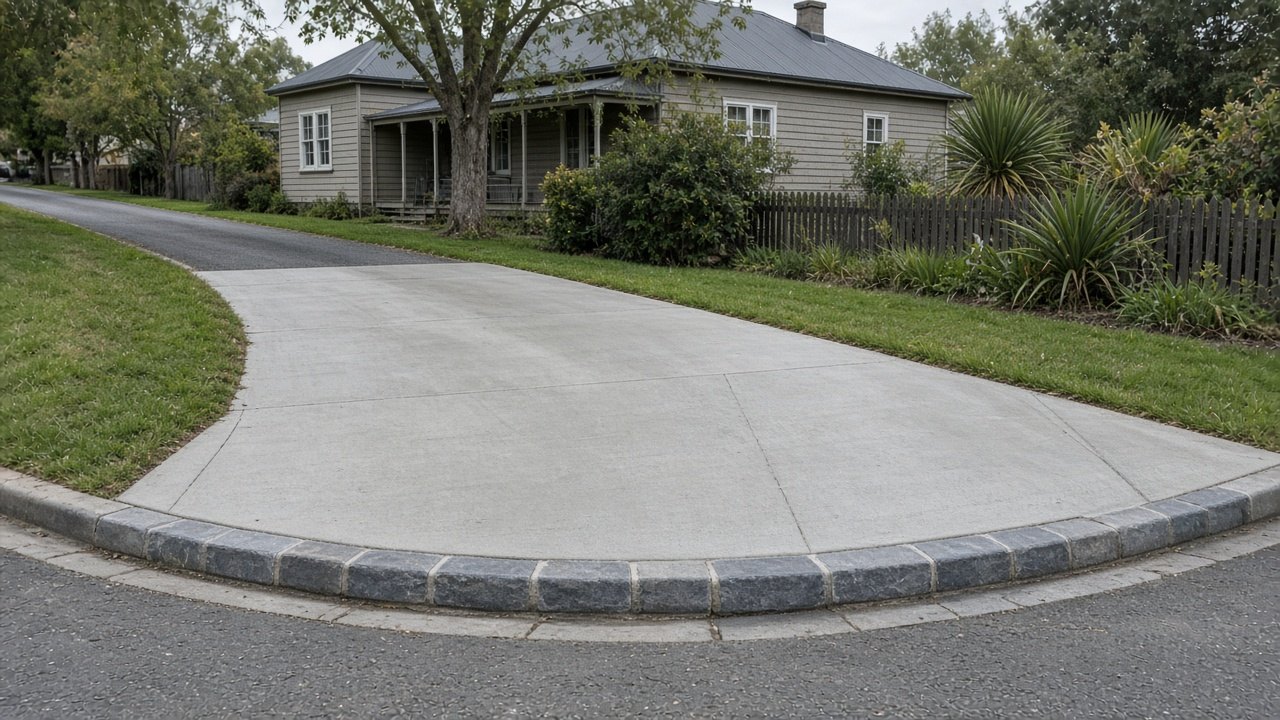
Vehicle crossovers in Korumburra
A crossover joins your driveway to the street across council land. In Korumburra that usually means steep transitions, kerb and channel, and South Gippsland Shire consent. We handle the levels, the paperwork and the pour.
Email: info@korumburraconcreting.com.au
What a crossover is
The crossover, sometimes called a vehicle crossing, is the section of driveway between your property boundary and the road. It crosses the nature strip, the footpath if there is one, and the kerb and channel. Because it sits on council land, it has to meet council requirements for location, width, levels and construction. It also has to work for your car, which on a hilly Korumburra street is not always easy.
Council consent and specifications
In South Gippsland Shire, works in the road reserve, including a new or altered crossover, generally require consent from the council before work starts. The council sets requirements for the crossover's construction, levels and the treatment of the kerb, channel and footpath. On a highway or main road frontage, the state road authority may also be involved. We confirm what applies to your property during the site visit and include the consent process in the quote.
Requirements change from time to time, so we check current council standards for each job rather than relying on what was done in the past.
Levels on steep streets
Many streets in Korumburra are steep or have steep nature strips. The crossover must connect the road to the property boundary at a grade that cars can manage without scraping, while keeping the footpath level within council limits and directing stormwater along the channel rather than into your driveway. Getting these transitions right is the most technical part of the job. We survey the levels and design the profile so it works for both the council and your car.
Where the property sits below the road, the crossover must also stop road water from running down your driveway. A raised hump, a grated drain at the boundary, or both, may be needed.
Kerb and channel
Some crossovers involve cutting and replacing a section of kerb with a lay-back or crossing kerb. Others connect to existing kerb crossings. Older streets may have bluestone or concrete kerbs, and rural roads may have no kerb at all, with an open table drain beside the road. Each situation needs a different approach. In rural areas, a culvert pipe under the crossover is often needed to carry the table drain, and the pipe size and end walls are usually set by council.
Footpaths and nature strips
Where a public footpath crosses the driveway, the crossover must provide a safe, continuous footpath for pedestrians. That usually means a thicker, reinforced section where the path meets the crossover. We reinstate the nature strip around the crossover neatly with topsoil and seed or turf as agreed.
Construction
Crossovers carry heavier loads than many driveways, including delivery trucks, bins trucks reversing, and visitors' vehicles. They are generally built thicker and with reinforcement as specified by council. We excavate, prepare a compacted base, set formwork and steel, pour and finish to council standard. Inspections are booked where council requires them.
Replacing an old crossover
Old crossovers often crack, sink or no longer suit the driveway. If you are replacing the driveway, it is usually sensible to replace the crossover at the same time so levels and finishes match. Council consent is still needed. We remove the old crossover, rebuild the base and pour a new one to current standards.
Rural entrances
On farm and acreage properties, the entrance from the road often includes a culvert crossing, a wide splay for trucks and floats, and a gate set back from the road. We can concrete the entrance, the culvert end walls and the first section of driveway so the most heavily used area stays solid through winter.
Our process
We visit, measure and check levels, then confirm council requirements. Your quote covers the consent process, kerb works, footpath works, thickness, steel and reinstatement. Once consent is granted, we schedule the work and keep the road and footpath safe and tidy during construction.
Crossovers on corner blocks and shared driveways
Corner blocks and shared driveways bring extra considerations. On a corner, council rules usually limit how close a crossover can be to the intersection, and sight lines matter. On a shared driveway, the crossover serves more than one property, so all owners need to agree on the work, and the costs are often shared. We can explain the options and help coordinate between neighbours.
Timing with a new home build
For new homes, builders often leave the crossover until the end of the build, because heavy trucks can damage a new crossover. We coordinate with your builder to pour the crossover and driveway together after the heavy work has finished, so the new concrete is not damaged by delivery trucks.
Reinstating the nature strip
After the crossover is poured and cured, the nature strip around it needs to be reinstated. We backfill the edges, spread topsoil and seed or lay turf as agreed, so the street frontage looks tidy and the edges of the new crossover are supported.
Rural crossings without kerbs
Many roads outside Korumburra township have no kerb, just a gravel shoulder and an open table drain. A crossover here usually needs a culvert pipe sized by council, end walls to protect the pipe ends, and a concrete or sealed apron that ties into the road edge without breaking it up.
Korumburra clay, slopes and South Gippsland rules
Korumburra sits high in the hills of South Gippsland, at the edge of the Strzelecki foothills, in country that was cleared for dairying and once mined for black coal. Under the grass most blocks have heavy, reactive clay over weathered sandstone and mudstone. That clay swells in a wet winter and shrinks in a dry summer, and on a slope it also wants to creep downhill. A slab poured thin, straight onto it, will crack and move.
So we dig to firm ground, take out topsoil and soft material, compact crushed rock in layers, set steel on chairs, and plan joints and drainage before the pour. Falls are designed to take water safely down the hill, away from the house and garage, to a legal point of discharge. High rainfall makes compaction harder in winter, and frost and cold slow curing, so we plan around the season. Concrete inside your boundary rarely needs a council permit. Work in the road reserve, such as a crossover, nature strip or public footpath, generally needs the council's consent. A slab that carries a building needs a building permit and engineering. Your quote spells out which of these apply.
How a Korumburra quote is put together
Every quote we send is written and itemised. It sets out the area we measured, the digging and where the spoil or old concrete will go, the compacted crushed-rock base, the slab thickness, the steel and how it is supported, the finish, any sealer, and the extras that hilly blocks often need: drains, steps, a small wall, a landing or a new crossover. If South Gippsland Shire, the state road authority or a building surveyor has to be involved, the quote names that up front.
It also covers the practical side of pour day: where the truck or pump can stand on a steep street, how we protect gardens, fences and the footpath, and how long the area must stay closed. If we suspect the ground hides a problem, such as wet clay, an old slab, a spring or a buried pipe, we say so and explain how we would deal with it. There are no prices on this website because two blocks on the same Korumburra street can need very different work. The visit and the written quote cost you nothing.
What you get with Korumburra Concreting
Local to Korumburra 3950
We work the town first, then the South Gippsland towns and farming districts we actually drive to every week.
Built for hills, clay and rain
Deeper prep where reactive clay needs it, compacted bases, and falls that take water safely down a sloping block.
Free written quotes
Every job is itemised. No website rates, no pressure, and no charge to visit or to send the quote.
Home and farm work
From house slabs and driveways to machinery shed floors and yards, with council and permit steps named in the quote.
Six steps to a finished job
- 1
Get in touch
Call, email or send the form with a few photos of the area, the street frontage and any steep or tight access.
- 2
Site visit
We measure, check the levels and the slope, look at the ground and drainage, and bring finish samples to hold against the house.
- 3
Written quote
You get an itemised quote covering digging, base, thickness, steel, finish, drains and any council or permit work.
- 4
Base and formwork
We remove old concrete or topsoil, dig out soft clay, compact the base, set the forms and place the steel on chairs.
- 5
Pour and finish
Concrete is placed, levelled and finished for grip on the slope, then protected while it cures in the week's weather.
- 6
Clean-up and care
We strip the forms, cut joints, take the rubble away, seal if it was quoted, and leave written care notes.
Crossovers questions
Do I need council approval for a crossover?
In most cases, yes. Works in the road reserve generally need South Gippsland Shire consent before they start. We confirm the requirements for your property and include the process in the quote.
Who pays for the crossover?
The property owner usually pays for a new or altered crossover. The crossover remains on council land, but owners are commonly responsible for its upkeep.
Can I choose the finish of my crossover?
Council often specifies the finish and colour for the crossover. Plain broomed concrete is common. Decorative finishes usually start at the property boundary.
What if my property is below the road?
We design the crossover so road water stays in the channel, and add a drain at the boundary if needed.
Where we work
Other concreting services
Talk to a Korumburra concreter
We visit, measure and put it in writing for work in Korumburra 3950 and the South Gippsland towns around it. Nothing on this site is priced, because no two blocks are the same.