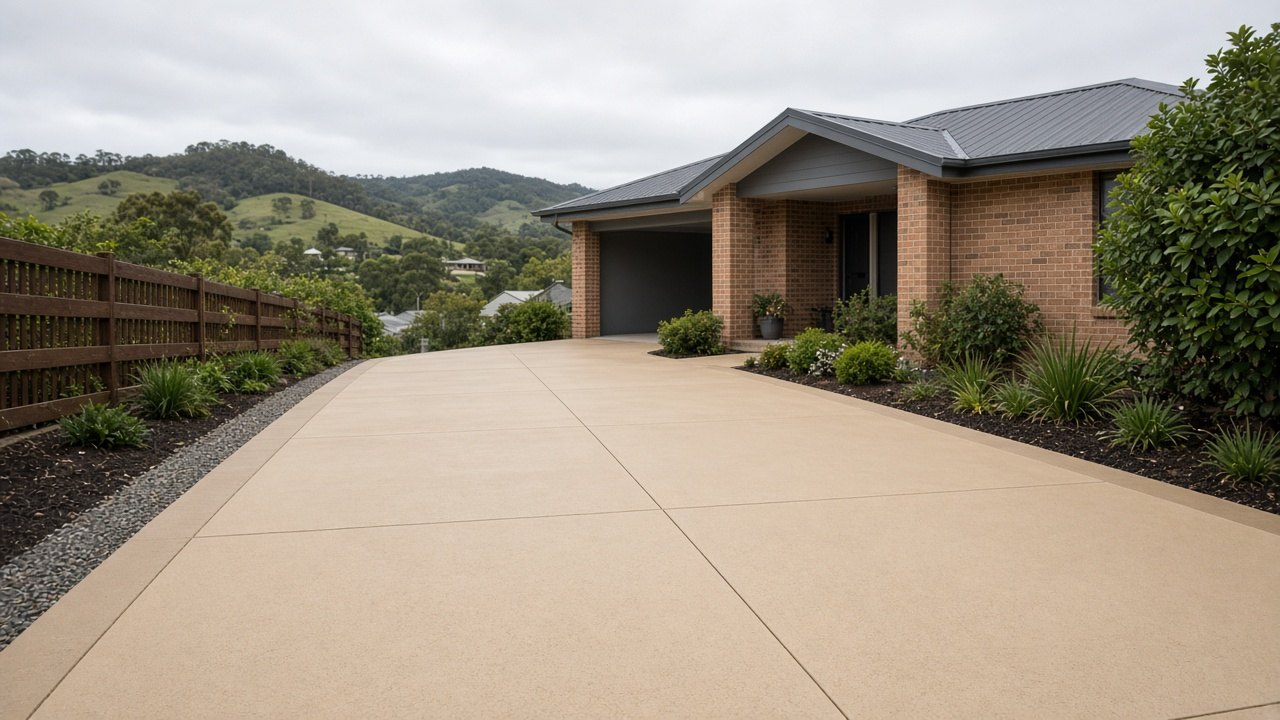
Coloured concrete in Korumburra
Coloured concrete gives a Korumburra home a softer, more finished look than plain grey. We help you choose a colour that suits the house, the hills and the clay, and pour it on a base built for this ground.
Email: info@korumburraconcreting.com.au
Colour that belongs to the house
Coloured concrete uses oxide pigments mixed through the concrete so the colour runs right through the slab rather than sitting on the surface. It suits driveways, paths, patios and pool surrounds, and it is a popular way to make a new or replaced driveway look like part of the house rather than an afterthought. In Korumburra we see it most often on brick homes where a charcoal or sandstone driveway picks up the roof or brick tones, and on renovated weatherboards where a soft grey lifts the frontage without shouting.
Choosing the right shade
Suppliers offer a wide range of colours, from light sandstone and buff through to mid greys, terracotta and deep charcoal. The colour you see on a sample card is a guide only. Concrete colour depends on the cement, the sand, the finishing technique, the weather on pour day and how the slab is cured. We bring physical samples and look at them in daylight against your bricks, weatherboards, roof and garden.
Practical thinking helps. Very light colours can show tyre marks and mud. Very dark colours can show efflorescence, the white bloom that sometimes appears as concrete dries, and they get hot in summer sun. Mid tones are often the most forgiving on a busy family driveway, especially with Korumburra's red-brown clay tracked in through winter.
Finishes for coloured concrete
Coloured concrete can be broom finished for grip, steel trowelled for a smooth patio, or given a light texture. On steep driveways, a broom finish is usually the safest choice. A coloured broomed field with a smooth trowelled border band is a classic look that gives grip in the wheel tracks and a crisp edge. Coloured concrete can also be combined with exposed aggregate or plain concrete in borders and bands.
Consistency across a pour
Because colour can vary slightly between trucks, we plan pours so a single visible area comes from consistent batches where possible, and we use joints and borders to separate pours that must be done on different days. Finishing technique and curing are kept consistent across the whole job. Uneven curing, such as plastic sheeting laid directly on part of a slab, can cause blotchy colour, so we use curing methods suited to coloured work.
The base matters just as much
Colour does not change what is underneath. Korumburra's reactive clay and sloping blocks still need proper excavation, compacted crushed rock, steel on chairs and planned saw-cut joints. A coloured slab that cracks randomly looks worse than a plain one because the cracks catch dirt and stand out against the colour. We put the same care into the base as we do on any driveway.
Sealing coloured concrete
Sealing deepens and evens out the colour, protects against staining from oil, leaves and barbecue fat, and makes cleaning easier. It is especially worthwhile on darker colours and on outdoor living areas. On driveways and slopes we use sealers suited to trafficked outdoor areas and can add a slip-resistant additive. Sealers wear and need reapplying every few years depending on sun and traffic.
Where coloured concrete works best
Front driveways where kerb appeal matters, patios and alfresco areas that connect to the house, paths around the garden, and pool surrounds are the most common uses. On long rural driveways, coloured concrete is often used at the house end with plain concrete on the working sections further out, which keeps the look where it matters and the practicality everywhere else.
Repairs and additions
Matching coloured concrete years later is difficult because of weathering and batch variation. If you are adding a new section next to an older coloured slab, a border or a deliberate change in finish often looks better than trying for an exact match. For tired coloured concrete that has faded, a clean and reseal can restore a lot of depth without new concrete.
Our site visit
On the visit we measure, check levels and drainage, look at the ground, and talk through colours with samples in hand. Your written quote describes the colour, finish, base, thickness, steel, joints and any sealing, so you know exactly what you are getting.
Coloured concrete on sloping driveways
On steep Korumburra driveways, a coloured slab is usually given a firm broom finish for grip, sometimes with a smooth border band. Because steep drives are often poured in sections, we plan consistent mixes and finishing across each pour so the colour stays even from top to bottom.
Colour and older homes
On older weatherboard homes around Korumburra's established streets, softer, earthy colours tend to suit the house better than strong modern tones. A warm grey or sandstone driveway can make a period home look cared for without looking out of place. We are happy to suggest colours that sit naturally with your house and garden.
Samples on site, not on a screen
Screens and printed brochures rarely show concrete colour accurately. On the visit we lay physical samples on the ground beside your house, in natural light, so you can judge the colour against your bricks, cladding, roof and garden before you decide.
Korumburra clay, slopes and South Gippsland rules
Korumburra sits high in the hills of South Gippsland, at the edge of the Strzelecki foothills, in country that was cleared for dairying and once mined for black coal. Under the grass most blocks have heavy, reactive clay over weathered sandstone and mudstone. That clay swells in a wet winter and shrinks in a dry summer, and on a slope it also wants to creep downhill. A slab poured thin, straight onto it, will crack and move.
So we dig to firm ground, take out topsoil and soft material, compact crushed rock in layers, set steel on chairs, and plan joints and drainage before the pour. Falls are designed to take water safely down the hill, away from the house and garage, to a legal point of discharge. High rainfall makes compaction harder in winter, and frost and cold slow curing, so we plan around the season. Concrete inside your boundary rarely needs a council permit. Work in the road reserve, such as a crossover, nature strip or public footpath, generally needs the council's consent. A slab that carries a building needs a building permit and engineering. Your quote spells out which of these apply.
How a Korumburra quote is put together
Every quote we send is written and itemised. It sets out the area we measured, the digging and where the spoil or old concrete will go, the compacted crushed-rock base, the slab thickness, the steel and how it is supported, the finish, any sealer, and the extras that hilly blocks often need: drains, steps, a small wall, a landing or a new crossover. If South Gippsland Shire, the state road authority or a building surveyor has to be involved, the quote names that up front.
It also covers the practical side of pour day: where the truck or pump can stand on a steep street, how we protect gardens, fences and the footpath, and how long the area must stay closed. If we suspect the ground hides a problem, such as wet clay, an old slab, a spring or a buried pipe, we say so and explain how we would deal with it. There are no prices on this website because two blocks on the same Korumburra street can need very different work. The visit and the written quote cost you nothing.
What you get with Korumburra Concreting
Local to Korumburra 3950
We work the town first, then the South Gippsland towns and farming districts we actually drive to every week.
Built for hills, clay and rain
Deeper prep where reactive clay needs it, compacted bases, and falls that take water safely down a sloping block.
Free written quotes
Every job is itemised. No website rates, no pressure, and no charge to visit or to send the quote.
Home and farm work
From house slabs and driveways to machinery shed floors and yards, with council and permit steps named in the quote.
Six steps to a finished job
- 1
Get in touch
Call, email or send the form with a few photos of the area, the street frontage and any steep or tight access.
- 2
Site visit
We measure, check the levels and the slope, look at the ground and drainage, and bring finish samples to hold against the house.
- 3
Written quote
You get an itemised quote covering digging, base, thickness, steel, finish, drains and any council or permit work.
- 4
Base and formwork
We remove old concrete or topsoil, dig out soft clay, compact the base, set the forms and place the steel on chairs.
- 5
Pour and finish
Concrete is placed, levelled and finished for grip on the slope, then protected while it cures in the week's weather.
- 6
Clean-up and care
We strip the forms, cut joints, take the rubble away, seal if it was quoted, and leave written care notes.
Coloured Concrete questions
Does coloured concrete fade?
The pigment runs through the concrete, so it does not wear off like paint. Sun and weather can soften the surface tone over time. A good sealer helps protect and refresh the colour.
Why does my coloured concrete have white patches?
That is usually efflorescence, salts drawn to the surface as concrete dries. It is more visible on darker colours and often reduces over time. It can be cleaned and sealed once the slab has dried.
Which colour hides dirt best?
Mid greys and earthy tones usually hide dirt, tyre marks and clay best. Very light and very dark colours tend to show marks more.
Can you add colour to existing concrete?
Colour cannot be mixed into an existing slab, but sound concrete can sometimes be refreshed with a resurfacing system or a tinted sealer. We assess whether that is worthwhile.
Where we work
Other concreting services
Talk to a Korumburra concreter
We visit, measure and put it in writing for work in Korumburra 3950 and the South Gippsland towns around it. Nothing on this site is priced, because no two blocks are the same.