Stamped and stencil concrete in Korumburra
Stamped and stencil concrete can give a Korumburra patio, path or driveway the look of stone, slate or brick in one continuous slab. We are honest about where it works on hilly, wet sites and where a simpler finish is wiser.
Email: info@korumburraconcreting.com.au
What stamped and stencil concrete are
Stamped concrete is coloured concrete that is pressed with textured mats while it is still plastic, leaving the pattern and feel of stone, slate, cobbles or timber. A contrasting release colour is usually applied so the joints and texture read clearly. Stencil concrete uses paper stencils laid on the fresh surface, then a coloured hardener is applied over the top. When the stencil is lifted, the grout lines show in the base colour, creating the look of tiles, pavers or brick.
Both finishes create a decorative surface as part of a single slab, without the individual units of real paving that can move, sink or grow weeds between them.
Where it suits Korumburra homes
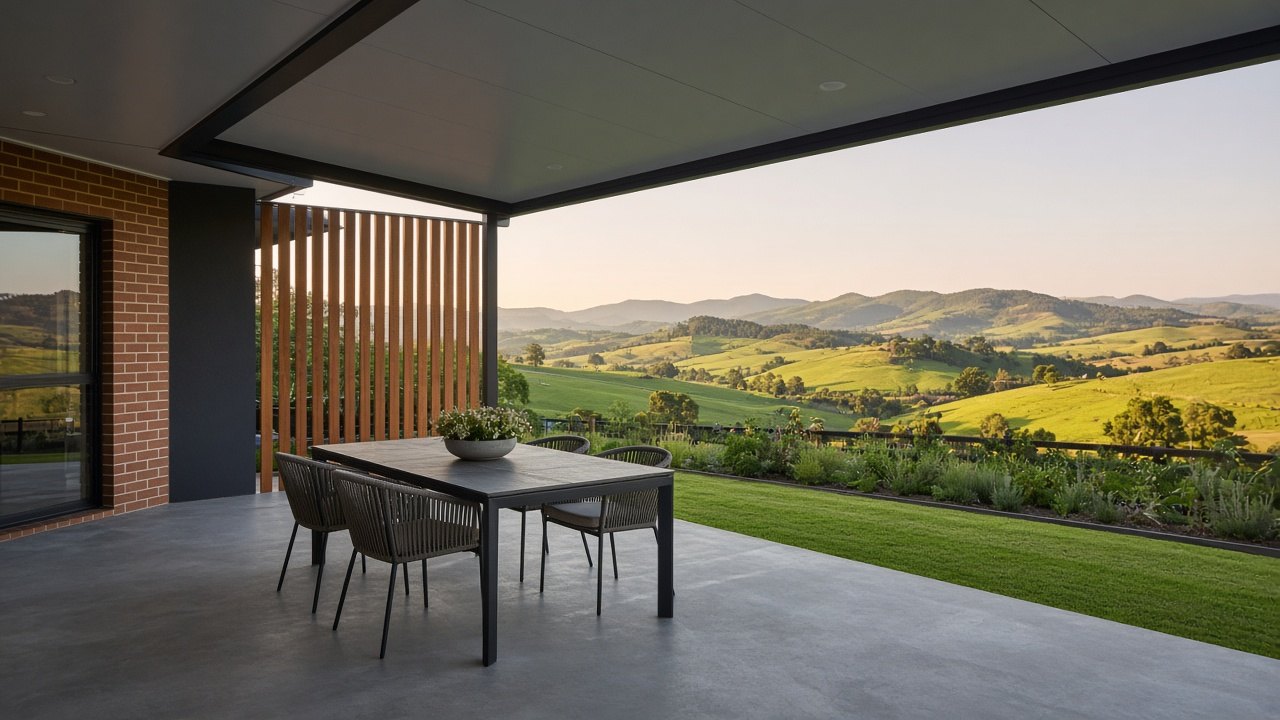
Stamped and stencil finishes are most popular on patios, alfresco areas, entry paths and pool surrounds, where people want a decorative feel close to the house. A slate or flagstone pattern can suit a country home looking over the hills, while a brick or cobble stencil can suit an older weatherboard or a brick period home in one of the established streets near the town centre. On driveways, a stamped border or a stencilled band can add interest without covering the whole area.
Slopes, rain and grip
This is where we are careful. Stamped concrete is usually sealed, and some sealers can become slippery when wet. On flat patios and gentle paths that is manageable with the right sealer and an anti-slip additive. On steep Korumburra driveways and paths, where rain, frost, moss and leaves are common, a heavily textured or deeply sealed decorative surface may not be the safest choice. We will tell you if we think exposed aggregate or a broom finish would be better on a steep section, and suggest using the decorative finish on flatter areas such as the patio or landing.
Choosing pattern and colour
There are many patterns available: random stone, ashlar slate, cobblestone, herringbone brick, timber boards and more. We bring samples and photos so you can see how a pattern looks at full size. Colours are chosen as a base colour and a release or highlight colour. Natural stone tones, soft greys and earthy colours tend to suit the green South Gippsland landscape best, but the final choice depends on your house.
Pattern scale matters. A large random stone pattern can make a small courtyard feel busy, while a small brick pattern on a large area can look repetitive. We talk through the layout so the pattern suits the space.
The base still decides the outcome
Decorative surfaces show cracks clearly. Korumburra's reactive clays and slopes need proper excavation, a compacted crushed-rock base, steel on chairs and planned control joints. On stamped work we try to place joints along pattern lines so they blend in. On stencil work, joints can be aligned with grout lines. Good drainage is essential so water does not sit on the surface or undermine the edges.
Sealing and maintenance
Stamped and stencil concrete is almost always sealed to protect the colour, lock in the release agent and make cleaning easier. We use sealers suited to outdoor trafficked areas and add slip-resistant additives where needed. Sealers wear over time and should be reapplied every few years, depending on traffic and sun exposure. Regular sweeping and hosing keeps the surface looking good. Avoid harsh chemicals that can damage the sealer.
Resealing older stamped concrete
Many older stamped driveways and patios around the district have faded, become patchy or lost their sealer. A thorough clean and a fresh coat of sealer can bring back much of the original colour and depth. If the sealer has turned white or cloudy, it may need to be stripped before resealing. We can assess what your existing surface needs.
Is stamped concrete right for you?
Stamped and stencil concrete give a decorative look that real paving offers, without loose units. They do need more upkeep than plain or exposed aggregate concrete because of resealing, and they are less forgiving on steep or shaded sites. On the site visit we look at the slope, shade, use and drainage and give you an honest recommendation. If another finish would serve you better, we will say so.
Stencil finishes on verandahs and porches
Many older Korumburra homes have verandahs and front porches with tired concrete floors. A stencilled finish with a brick or tile look can give these areas a period feel that suits the house, while being far easier to maintain than real tiles. Because verandahs are usually covered and flat, they are well suited to decorative finishes. We check the existing slab condition first; if it is sound, a stencil overlay may be possible without replacing the slab.
Choosing between stamped and exposed aggregate
Many Korumburra homeowners compare stamped concrete with exposed aggregate. Exposed aggregate is generally lower maintenance and grippier on slopes. Stamped concrete offers a stronger decorative pattern but needs regular resealing. We often suggest exposed aggregate for driveways and stamped or stencil finishes for flatter patios and verandahs.
Pattern alignment with joints
On stamped work, we try to place control joints along the pattern lines so they blend in rather than cutting across stones or bricks, which keeps the finish looking natural.
Korumburra clay, slopes and South Gippsland rules
Korumburra sits high in the hills of South Gippsland, at the edge of the Strzelecki foothills, in country that was cleared for dairying and once mined for black coal. Under the grass most blocks have heavy, reactive clay over weathered sandstone and mudstone. That clay swells in a wet winter and shrinks in a dry summer, and on a slope it also wants to creep downhill. A slab poured thin, straight onto it, will crack and move.
So we dig to firm ground, take out topsoil and soft material, compact crushed rock in layers, set steel on chairs, and plan joints and drainage before the pour. Falls are designed to take water safely down the hill, away from the house and garage, to a legal point of discharge. High rainfall makes compaction harder in winter, and frost and cold slow curing, so we plan around the season. Concrete inside your boundary rarely needs a council permit. Work in the road reserve, such as a crossover, nature strip or public footpath, generally needs the council's consent. A slab that carries a building needs a building permit and engineering. Your quote spells out which of these apply.
How a Korumburra quote is put together
Every quote we send is written and itemised. It sets out the area we measured, the digging and where the spoil or old concrete will go, the compacted crushed-rock base, the slab thickness, the steel and how it is supported, the finish, any sealer, and the extras that hilly blocks often need: drains, steps, a small wall, a landing or a new crossover. If South Gippsland Shire, the state road authority or a building surveyor has to be involved, the quote names that up front.
It also covers the practical side of pour day: where the truck or pump can stand on a steep street, how we protect gardens, fences and the footpath, and how long the area must stay closed. If we suspect the ground hides a problem, such as wet clay, an old slab, a spring or a buried pipe, we say so and explain how we would deal with it. There are no prices on this website because two blocks on the same Korumburra street can need very different work. The visit and the written quote cost you nothing.
What you get with Korumburra Concreting
Local to Korumburra 3950
We work the town first, then the South Gippsland towns and farming districts we actually drive to every week.
Built for hills, clay and rain
Deeper prep where reactive clay needs it, compacted bases, and falls that take water safely down a sloping block.
Free written quotes
Every job is itemised. No website rates, no pressure, and no charge to visit or to send the quote.
Home and farm work
From house slabs and driveways to machinery shed floors and yards, with council and permit steps named in the quote.
Six steps to a finished job
- 1
Get in touch
Call, email or send the form with a few photos of the area, the street frontage and any steep or tight access.
- 2
Site visit
We measure, check the levels and the slope, look at the ground and drainage, and bring finish samples to hold against the house.
- 3
Written quote
You get an itemised quote covering digging, base, thickness, steel, finish, drains and any council or permit work.
- 4
Base and formwork
We remove old concrete or topsoil, dig out soft clay, compact the base, set the forms and place the steel on chairs.
- 5
Pour and finish
Concrete is placed, levelled and finished for grip on the slope, then protected while it cures in the week's weather.
- 6
Clean-up and care
We strip the forms, cut joints, take the rubble away, seal if it was quoted, and leave written care notes.
Stamped and Stencil Concrete questions
Is stamped concrete slippery?
It can be when wet, especially with a glossy sealer. We use outdoor sealers with a slip-resistant additive and avoid recommending stamped finishes on steep driveways or paths.
How long does stamped concrete last?
The slab itself lasts for decades with a good base. The sealer needs reapplying every few years to keep the colour and protection.
What is the difference between stamped and stencil concrete?
Stamped concrete is pressed with textured mats to create a three-dimensional surface. Stencil concrete uses paper stencils to create grout lines in a flatter surface. Stencil is usually smoother underfoot.
Can stamped concrete be repaired?
Small repairs are possible but hard to match perfectly. Replacing whole sections between joints usually looks neater.
Where we work
Other concreting services
Talk to a Korumburra concreter
We visit, measure and put it in writing for work in Korumburra 3950 and the South Gippsland towns around it. Nothing on this site is priced, because no two blocks are the same.