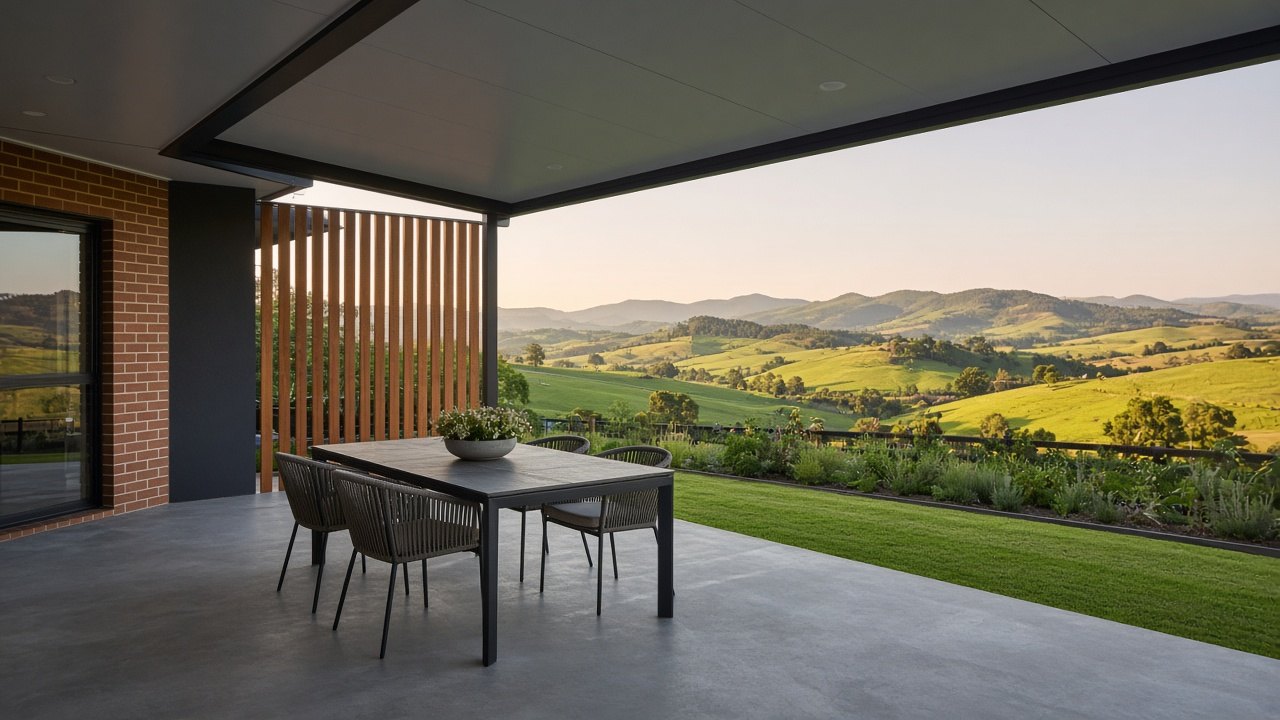
Concrete patios and alfresco areas in Korumburra
A concrete patio or alfresco slab in Korumburra should be level enough for furniture, fall gently away from the house, and cope with long wet winters. We plan the levels, drainage and finish around how you will use the space.
Email: info@korumburraconcreting.com.au
Outdoor living with a view
Many Korumburra homes look out over some of the best rolling country in Victoria, and a well-built patio or alfresco area is how you make the most of it. Whether it is a covered entertaining area under the roofline, a freestanding patio under a pergola, or a simple slab outside the back door for a table and chairs, the concrete underneath needs to be level, safe and durable through all seasons.
Levels and the step from the house
The relationship between the patio and the house floor is important. Building rules generally require a step down from the internal floor level to the outside slab to stop water entering the house, with the exact requirement depending on the situation. We check the floor level, the weep holes and the damp course on brick homes, and the cladding and bearers on weatherboard homes, so the new slab does not trap moisture against the house.
On sloping blocks, a patio may need to be built up on the low side, with a small retaining edge or step down to the lawn. On the high side, the slab may need to be cut into the slope, with a drain to catch water coming down the hill.
Falls and drainage
Patios need to fall gently away from the house so rain runs off, but not so much that tables wobble and chairs slide. We set the falls so water moves to the edge of the slab, into the garden or into a grated drain connected to stormwater. Where a patio is enclosed by walls or the house on several sides, a strip drain or pit is often needed. Korumburra's heavy rainfall makes this more important than in drier parts of the state.
Covered alfresco areas
If the patio will be covered by a roof or pergola, we coordinate with the builder or pergola installer. Posts may need footings poured with or before the slab, and some designs need brackets or bolts cast in. If the roof will drain into downpipes, we plan where that water will go. A slab under a solid roof stays dry and is ideal for an outdoor kitchen, so we discuss whether you need services such as power, gas or water run under the slab before we pour.
Finishes for outdoor living
Patio finishes are about comfort, cleaning and grip. A smooth trowelled finish looks modern and is easy to sweep, but it needs a slip-resistant sealer if it will get wet. A light broom finish gives grip and is comfortable for bare feet. Exposed aggregate in a fine stone gives a natural look and good grip. Coloured concrete can tie the patio to the house. Stamped or stencil patterns can create the look of stone or tiles. We bring samples and talk through what suits the space and how you live.
Sealing patios
Sealing protects patios from stains caused by food, drinks, barbecue fat, leaves and pot plants. On covered patios, a sealer also helps with cleaning. On uncovered patios, choose a sealer with good UV resistance and grip. We explain the options and how often sealers typically need reapplying.
Base preparation
A patio slab on Korumburra clay still needs proper preparation. We remove topsoil and grass, excavate to firm ground, compact crushed rock and set steel on chairs. Control joints are planned so cracks occur in neat lines. Isolation joints separate the patio from the house slab and footings so the two can move independently.
Fire pits, steps and connections
Patios often connect to paths, steps, retaining walls or a lawn area. We can pour steps down to the garden, a path to the clothesline or shed, or a fire pit pad. Planning these together gives a consistent finish and avoids awkward joins later.
Replacing an old patio
Old patios often have problems: cracked slabs, slabs that slope towards the house, or pavers that have sunk and grown weeds. We remove the old surface, fix the levels and drainage, and pour a new slab that falls the right way. If an old slab is structurally sound but tired, resurfacing or sealing may be an option.
Planning for winter use
Korumburra winters are long and wet, so a patio that is usable year-round is worth planning for. A slab under a solid roof, with the falls designed so wind-driven rain drains away, extends the season considerably. Think about where an outdoor heater, fire pit or lighting might go, and allow for power conduits under the slab before we pour.
Patios that connect to the garden
A patio works best when it connects naturally to the lawn, garden and paths. Steps down to the lawn, a path to the vegetable garden or a level link to the driveway all make the space more usable. We plan these connections during the quote, so the finished patio feels part of the property.
Furniture and shade
Think about your table size, barbecue position and where shade falls during the day. We can size the patio so furniture fits comfortably with room to walk around it.
Korumburra clay, slopes and South Gippsland rules
Korumburra sits high in the hills of South Gippsland, at the edge of the Strzelecki foothills, in country that was cleared for dairying and once mined for black coal. Under the grass most blocks have heavy, reactive clay over weathered sandstone and mudstone. That clay swells in a wet winter and shrinks in a dry summer, and on a slope it also wants to creep downhill. A slab poured thin, straight onto it, will crack and move.
So we dig to firm ground, take out topsoil and soft material, compact crushed rock in layers, set steel on chairs, and plan joints and drainage before the pour. Falls are designed to take water safely down the hill, away from the house and garage, to a legal point of discharge. High rainfall makes compaction harder in winter, and frost and cold slow curing, so we plan around the season. Concrete inside your boundary rarely needs a council permit. Work in the road reserve, such as a crossover, nature strip or public footpath, generally needs the council's consent. A slab that carries a building needs a building permit and engineering. Your quote spells out which of these apply.
How a Korumburra quote is put together
Every quote we send is written and itemised. It sets out the area we measured, the digging and where the spoil or old concrete will go, the compacted crushed-rock base, the slab thickness, the steel and how it is supported, the finish, any sealer, and the extras that hilly blocks often need: drains, steps, a small wall, a landing or a new crossover. If South Gippsland Shire, the state road authority or a building surveyor has to be involved, the quote names that up front.
It also covers the practical side of pour day: where the truck or pump can stand on a steep street, how we protect gardens, fences and the footpath, and how long the area must stay closed. If we suspect the ground hides a problem, such as wet clay, an old slab, a spring or a buried pipe, we say so and explain how we would deal with it. There are no prices on this website because two blocks on the same Korumburra street can need very different work. The visit and the written quote cost you nothing.
What you get with Korumburra Concreting
Local to Korumburra 3950
We work the town first, then the South Gippsland towns and farming districts we actually drive to every week.
Built for hills, clay and rain
Deeper prep where reactive clay needs it, compacted bases, and falls that take water safely down a sloping block.
Free written quotes
Every job is itemised. No website rates, no pressure, and no charge to visit or to send the quote.
Home and farm work
From house slabs and driveways to machinery shed floors and yards, with council and permit steps named in the quote.
Six steps to a finished job
- 1
Get in touch
Call, email or send the form with a few photos of the area, the street frontage and any steep or tight access.
- 2
Site visit
We measure, check the levels and the slope, look at the ground and drainage, and bring finish samples to hold against the house.
- 3
Written quote
You get an itemised quote covering digging, base, thickness, steel, finish, drains and any council or permit work.
- 4
Base and formwork
We remove old concrete or topsoil, dig out soft clay, compact the base, set the forms and place the steel on chairs.
- 5
Pour and finish
Concrete is placed, levelled and finished for grip on the slope, then protected while it cures in the week's weather.
- 6
Clean-up and care
We strip the forms, cut joints, take the rubble away, seal if it was quoted, and leave written care notes.
Patios and Alfresco questions
How much fall should a patio have?
Enough to shed water without making furniture unstable. We set a gentle fall away from the house and toward a garden edge or drain, suited to the size and finish of the patio.
Can you pour a patio up against my house?
Yes, with the correct step down from the floor level and an isolation joint. We also make sure the slab does not cover weep holes or bridge the damp course.
What is the best finish for a patio?
It depends on use and exposure. Fine exposed aggregate and light broom finishes give good grip. Smooth trowelled finishes look sleek but need a slip-resistant sealer if they will get wet.
Do I need a permit for a patio?
A concrete slab alone usually does not, but a roof, pergola or verandah often does. Your builder or building surveyor can confirm.
Where we work
Other concreting services
Talk to a Korumburra concreter
We visit, measure and put it in writing for work in Korumburra 3950 and the South Gippsland towns around it. Nothing on this site is priced, because no two blocks are the same.